
Meet the Research Scientist Helping Drive the Choctaw Nation’s Grant Growth, Health Solutions
Written by Olivia Fellows, TribalHub Industry Engagement & Narrative Producer in General Articles
Date: November 9, 2026
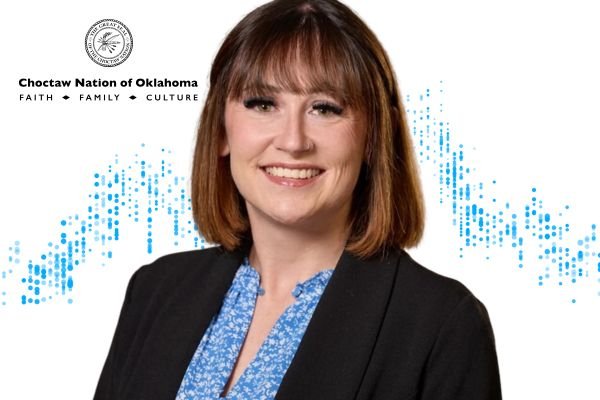
DURANT, Okla. — For Ashley Nunley, a Research Scientist in the Choctaw Nation of Oklahoma’s Tribal Research Department, a typical workday can range from editing a historical manuscript to resolving technical database issues in a custom application.
"My elevator pitch for what our department does is we collect and analyze data for program evaluation," Nunley said. "You don't know day to day. You have an idea of what you're going to come in and do each day, but we have a lot of projects going at once, and we can pivot, so it doesn't get boring."
Nunley's professional background began in public education, where she served students in classroom settings. Seeking a broader community impact, she transitioned to public library systems, working extensively in children's services while earning her Master of Library and Information Studies (MLIS).
After relocating to Durant, home to the Choctaw Nation headquarters, she joined the tribe's grants department to manage compliance and reporting for federally funded programs. That experience led to her current role in tribal research.
Evaluating Programs & Supporting Community Needs
The research department works across a wide range of initiatives for the Choctaw Nation.
Project scope ranges from observing summer school classrooms for the Posse educational program to drafting business cases for language expansion tools like Rosetta Stone and serving as editorial staff on an upcoming Choctaw history book.
A primary pillar of the department's mission is evaluating federally funded grants, including high-impact behavioral health initiatives designed to address the opioid epidemic. Data collected by Nunley’s team tracks performance metrics for peer recovery support specialists, counselors, case managers, and medication management programs.
"The data that we collect and provide can be used to justify the need for certain funding, but it also tells you where to look for funding," Nunley explained.
Over four iterations of the tribe's opioid response grant, evaluation metrics revealed a steady increase in client demand for peer support and direct counseling rather than medication-assisted treatments alone. In response to heavy counselor caseloads, program leadership realigned staff positions to add more counselors.
"I want to make sure that we're capturing data for what sorts of grants we can apply for in the future and what direction the nation needs to go," Nunley said. "Seeing the numbers is impactful. Our report was up to almost 700 clients for just this fiscal year, and knowing that we were able to touch 700 tribal lives for the better is obviously a huge thing."
To guide program development across various departments, the team also designs and conducts community needs assessments. Surveys distributed to tribal members, non-members, and Certificate of Degree of Indian Blood (CDIB) holders ensure services align directly with local priorities, while cultural coordinators help integrate Choctaw heritage into grant activities.
Upholding Indigenous Data Sovereignty
Upholding Indigenous Data Sovereignty
Alongside internal research, the team enforces strict protocols to protect indigenous data sovereignty. All department personnel undergo Human Subjects Research (CITI) training, which addresses historical context and ethical practices in Native American communities. Department leadership also serves on the Choctaw Nation Institutional Review Board (IRB), reviewing all external research proposals involving the tribe.
"We are a sovereign nation. We own all of our data, which is why it's important that we've moved to that framework from using outside evaluators," Nunley said. "We give the federal government what they have to know, and then everything else is for our internal planning."
By maintaining in-house research capabilities rather than relying on external contractors, the tribe cuts evaluation costs, allowing funds to return directly to member services while keeping sensitive community data fully under tribal governance.
Looking ahead, Nunley sees the department's framework as a potential blueprint for other tribal nations seeking to strengthen data autonomy.
"Our hope is that we can use our tribal research department as a model to help other tribes go down sort of the same path we have," Nunley noted. "We control our tribal members' data, where that goes, what's shared, all of those data sovereignty things, and we would love to be able to share that out as much as possible."
For more information on the Choctaw Nation of Oklahoma and its resources, click here.