
La Jolla Band of Luiseño Indians Builds Resilient Emergency Communications, Secures Critical Infrastructure
Written by Olivia Fellows, TribalHub Industry Engagement & Narrative Producer in General Articles
Date: November 23, 2026
When wildfires, flooding, or regional power outages strike rural areas, outside emergency assistance can take days to arrive. For the La Jolla Band of Luiseño Indians, that reality is driving a comprehensive overhaul of its communications networks and critical infrastructure to ensure the community can operate independently during a crisis.
Led by Sam Babbitt, the Tribe's Director of IT and Cybersecurity, Project EAGLE prioritizes operational resilience, cybersecurity, and financial sustainability while safeguarding sensitive operational details.
Rather than operating a single, flat network, Babbitt's team is structuring the communications environment as a federated network of networks. Public safety, critical infrastructure, government operations, field communications, and public internet services are separated into distinct security zones with controlled connections between them.
"We do not publicly disclose detailed network topology, security rules, or prioritization configurations, but the guiding principle is fairly simple: critical communications should not depend upon or share the same trust boundaries as ordinary public internet usage," Babbitt said.
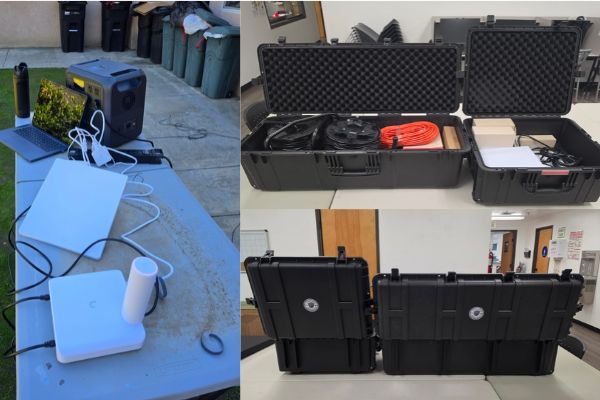
The centerpiece of the effort is a layered, transport-independent deployable communications system designed to keep field teams connected if primary backhaul infrastructure fails.
Depending on mission requirements and location, an approved deployment can establish a secure local operational network and connect outward using terrestrial broadband, cellular public-safety services, fixed wireless, satellite connectivity, or local wireless networking, supported by backup batteries, solar charging, and uninterruptible power supply systems.
Babbitt initially explored commercial off-the-shelf deployable systems, but vendor quotes proved financially unsustainable for a tribe without casino or oil revenue. Instead of shelving the concept, he broke down the required capabilities and assembled the first prototype, EAGLE-1, component by component.
"By the time the first kit came together, I realized we had created the core capability we were looking for at a cost substantially below the commercial systems I had been quoted," Babbitt said. "That affordability matters. Smaller and rural tribal nations should not have to choose between having resilient emergency communications and being able to afford them."
The IT team plans to deploy EAGLE-1 for a full workday in an area of the reservation with limited cellular and land-mobile-radio coverage to evaluate power consumption, connectivity, and system performance under real-world conditions.
"If something doesn't work, great," Babbitt said. "I want to find that out during a field test, not during an emergency. We will fix it, document what we learned, and test it again."
Beyond field communications, the tribe is modernizing and protecting operational technology across its water, solar, and battery energy storage systems. Those supervisory control and data acquisition environments, known as SCADA, are isolated from standard business networks and the open internet.
Safeguards include strict network segmentation, encrypted remote access, strong authentication, least-privilege access controls, restricted vendor connectivity, continuous monitoring, and dedicated incident-response plans.
Across the reservation's terrain, where a single last-mile connectivity method is impractical, the long-term infrastructure strategy combines fiber where feasible with fixed wireless and cellular links in harder-to-reach areas. Remote nodes are paired with site-specific backup power, including batteries, solar charging, and energy storage, sized according to each location's operational role.
Managing these initiatives with a two-person IT team requires embedding cybersecurity from the earliest planning stages, not adding protections after equipment is installed. Day-to-day work involves vetting vendors, defining access rules, testing recovery procedures, and occasionally slowing down timelines to prevent long-term vulnerabilities.
"With public safety and critical infrastructure, completing something quickly is not a success if we create a long-term security or operational risk for the tribe," Babbitt said.
The resilience strategy also extends to regional mutual aid. For nearly three years, Babbitt has advocated for a new FirstNet Band 14 tower to strengthen public-safety communications in the area. While the tower will add another layer of connectivity alongside tribal fiber, fixed wireless, satellite, and deployable systems, its broader impact will be felt by outside fire, law enforcement, and search-and-rescue personnel responding to regional emergencies.
"It is an investment not only in the tribe's emergency communications, but in the communications capabilities of the public-safety personnel who may someday be called here to help us," Babbitt said.
Babbitt said he views technology and cybersecurity as foundational tools for self-reliance and generational preparedness during severe weather, wildfires, or prolonged infrastructure disruptions.
"Ultimately, success is not measured by how much technology we deploy," Babbitt said. "Success is knowing that when something goes wrong, the tribe is better prepared to take care of its people until help arrives. And I think resilience and sovereignty are closely connected. Every capability the tribe can securely build, operate, govern, and sustain for itself makes it less dependent on circumstances outside its control and better prepared to protect the community for generations to come."